

Surface by surface
Where Shadazzle works
Your steel sink, your chrome faucet and your shower door each take the paste in their own way, and four materials in your house do not take it at all. Find the surface in front of you, see how the foam goes on, and where something else does the job.
Stainless steel: along the lines
Look closely at a stainless sink or the door of your fridge and you will see fine parallel lines from the polishing of the steel. Work the foam along those lines, never across them. The Specialty Steel Industry of North America gives the same rule in its care handbook, and it lays out an order that starts gentle: warm water with a mild detergent first, then a mild, non-scratching abrasive powder on a sponge or soft cloth when water alone leaves the marks behind.
The clay in Shadazzle belongs to that second step: a fine mineral powder carried on a damp sponge. On a mirror-bright or colored steel finish, try it first on a spot that does not show, since the handbook warns that abrasives can mark those finishes for good. Keep steel wool and carbon steel brushes away from your stainless altogether. The handbook explains that they leave tiny particles in the surface, and those particles rust.
Every clean ends the same way, with a rinse in clean water and a dry wipe. The handbook names that last step as the one that keeps water stains from forming, and on a steel sink it decides whether you see a shine or a basin of dried drops. Use the same order on a pot, a kettle or the front of a dishwasher: foam along the grain, rinse, dry.
Chrome faucets and fittings
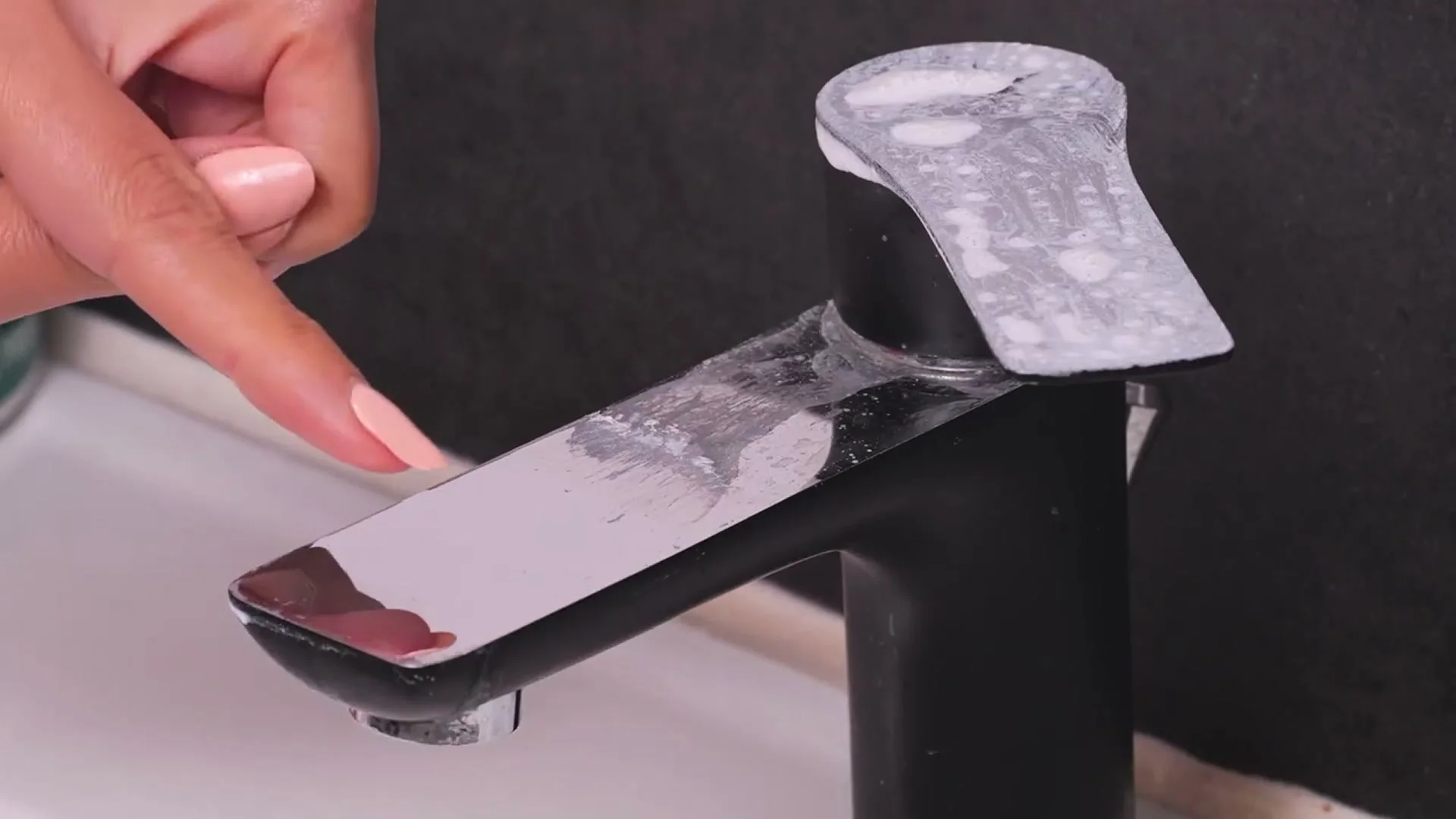
Chrome is on the label. On a faucet, hard water dries as white spots around the base and under the handle, and soap leaves a dull ring where your hands rest. Take a small amount of foam on the sponge, work around the base and up the spout, then rinse the faucet under its own running water.
Dry the chrome at once with a clean cloth. A bright metal shows every drop, and a faucet left to dry in the air spots again before the day is out. The nanofiber cloth suits this last wipe because it leaves no lint on the chrome. If a fitting is chrome-plated plastic, the plating is thin, so go lightly and try a corner first.
Around the drain of a basin and the overflow hole under the rim, rinse twice. Foam that hides in a crevice dries there later and shows as a white edge, the one spot your cloth cannot reach.
Porcelain and ceramics
A porcelain basin, a glazed ceramic splashback, the white front of a farmhouse sink: the label covers these as porcelain and ceramics. Soap rings and dull patches on white glaze are where you see the clay at work, and the rinse matters here as much as on steel.
Grout is a different material from the tile around it. Keep the foam on the glazed faces and rinse it out of the joints, so no paste dries in the grout lines. An acrylic bathtub is not on the label, so use a cleaner made for acrylic there. The label also leaves out heavy-duty or industrial shower cleaning, which means a shower with years of buildup on it needs a product made for that job.
Glass and glass shower doors
Glass is on the label, and glass shower doors are named on their own. The haze on a shower door is dried soap and water spots, layered up shower after shower. Work the foam over the door one section at a time, rinse each section from the top down, and dry the glass with a cloth before the next person showers.
A window or a mirror with only fingerprints and dust on it does not need the paste. The nanofiber cloth, damp and then dry, cleans that glass with water alone, and you save the paste for the spots water cannot move.
Glass cooktops: your manual first
Glass stovetops are on the Shadazzle label, but the people who make cooktop glass set their own rules, and their rules come first. SCHOTT, which makes CERAN glass-ceramic, describes a routine of a metal scraper for coarse dirt, a few drops of a suitable cooktop cleaner on a paper towel, and a clean cloth to wipe and dry. It warns against scouring pads and abrasives, and a clay paste is a mild abrasive.
Open your cooktop manual before the first try. If it rules out abrasive cleaners, follow it and keep the paste for the steel and the chrome around the stove. If it allows a mild cleaning paste, wait until the glass is cold and try one corner first. Use a small amount of foam with light pressure, lift it off with a damp cloth, and dry the glass. Paste left on black glass dries to a visible gray film, so the dry wipe matters more here than anywhere else in your kitchen.
Sugar, melted plastic or foil stuck to a hot cooktop is a job for the scraper, done straight away, as SCHOTT advises. The paste comes later, if your manual allows it at all.
Silverware and jewelry: lightly and rarely
Silverware and jewelry are on the label, and this is the surface where you hold back most. The Canadian Conservation Institute explains that tarnish is black silver sulfide formed by sulfur gases in the air, and that every polishing takes a little silver away with the tarnish and leaves fine scratches behind. It also says a general metal polish is harsher than a polish made for silver.
Our paste cleans many surfaces and is no silver polish. Keep it off silver-plated and gilded pieces altogether: CCI warns that any tarnish removal can badly damage plating, and that polishes damage gilding. On solid silver, use it lightly and rarely. Try it first on the back of a spoon or the inside of a ring, rinse well under warm water, and dry at once with a soft cloth, working into the tines of a fork and the claws of a setting where foam can hide. A ring with set stones or a plated finish deserves a jeweler's opinion before any paste touches it.
Tarnish comes back more slowly when silver is stored sealed in polyethylene bags, CCI adds, so whatever cleaning you do lasts longer and you reach for the paste less often.
Car wheels
Car wheels are on the label. Clean them when they are cool and out of direct sun, so the foam does not dry on the metal before you rinse. Work the damp sponge over the face of the wheel and between the spokes, rinse with a hose, and dry with a cloth. Painted, coated and matte wheels differ from car to car, so try the inside of the rim first, where a mark would stay out of sight.
Give the wheels a sponge of their own. Grit and brake dust from the road stay in the foam, and that sponge does not belong back on your kitchen sink or your shower door afterwards.
Where the paste does not go
The label leaves out four materials: brass, marble, natural stone and wood. Keep the tub away from a brass door handle, a marble counter, a granite or slate top and anything made of wood, even when the mark on it looks like the marks the paste lifts from steel.
Wood has its own product in our range. The Natural Wood Restorer goes on a cloth, is rubbed over finished and sealed wood, and is wiped off with a dry cloth. Two conservation references shape how to approach your furniture. The National Park Service says to clean beyond dusting only a sound, stable finish, and to test first in a small, hidden area. The Canadian Conservation Institute adds that water damages many finishes quickly, so damp cleaning is dried at once, and that a finish can blanch, turning white or cloudy.
That last point matters when you work on a white ring on a table. The ring sits in the finish, not in the wood, and how it responds depends on the finish. Wipe the spot with the restorer, wait two to three hours, wipe again, and see how yours takes it. CCI also notes that wood does not need oils fed back into it, so treat the restorer as a cleaner for the finish you see and touch.
| Surface | Use | Note |
|---|---|---|
| Stainless steel | Paste and sponge | Along the polish lines, then rinse and dry |
| Chrome | Paste and sponge | Dry at once, go lightly on plated plastic |
| Porcelain and ceramics | Paste and sponge | Rinse the foam out of the grout |
| Glass and shower doors | Paste and sponge, or the cloth alone | Damp cloth and water for fingerprints |
| Glass cooktops | Only if your manual allows a mild paste | Cold glass, one corner first, scraper for sugar |
| Silverware and jewelry | Lightly and rarely, solid silver only | Never on plated or gilded pieces |
| Car wheels | Paste and sponge, wheels cool | Inside of the rim first |
| Brass, marble, natural stone | Not the paste | A product made for that material |
| Finished wood | Natural Wood Restorer | Hidden spot first, wipe dry |
Every surface here comes from the label of the tub. Your cooktop manual and the care advice for your silver come before it.
The paste and the set that pairs it with two cloths sit on the cleaning paste shelf of the Shadazzle family of cleaners, and the stainless steel and glass stovetop pages go further into those two surfaces.
Ready to order
A brighter sink is one tub away
Every tub, bar, bottle and cloth in the Shadazzle family of cleaners opens at our retail partner with one press of the button, in the scent or pack you choose there.

Checkout, delivery and returns happen with our retail partner. Prices are from our last update.